Showing posts with label Saakashvili. Show all posts

Wednesday, October 5, 2011

"It's Nice to Meet You, Mr. President"

So, I haven't posted in a while. There have been a lot of things going on. School started. My host family punished their daughter by taking the internet away (and she didn't even know that that was her punishment. Very effective, eh?). Living in Tbilisi is a lot different than Telavi. And I was going to write about all of these things. But one event eclipsed all of those! I met Misha Saakashvili himself! The President of Georgia! How do you like that?!

It happened this past Saturday. TLG offers excursions for the teachers; basically they take us out to do something traditionally Georgian, or just to see more of Georgia. About two weeks ago they took 200 people living in Tbilisi on an overnight stay in Batumi to see an opera. Yours truly was not able to go because I didn't sign up in time. But it's that sort of thing- all paid for, transportation included, you get fed. Pretty good deal. So this weekend was an excursion to pick grapes in Kakheti- the region of Georgia most known for it's wine and also where I was living last semester. I signed up thinking it would be a nice thing to do on a Saturday. But a few days later I found out that the president was going to be there! I was incredibly surprised because he had been at the opera in Batumi and he had been to another excursion the week before. Nonetheless, it was still exciting!

Saturday got off to a cold and blustery start. We had to meet for the bus at the Radisson Hotel here in Tbilisi at 9am. One thing Georgia doesn't seem to be big on is transitional seasons. A few days earlier it had been in the upper 70s, but Saturday morning was down in the mid-50s and the wind cut through my thin blazer so easily. They had us waiting outside the buses for a good 45 minutes in the cold. No idea why; we were looking at the buses, but we still had to wait outside. By the time we arrived in Katchreti, the vineyard school where we would be picking the grapes, everyone was kind of cold and grumpy. It didn't help matters that we had to wait around for another half hour just to pick the grapes. The morning was pretty unorganized. But everything got very organized very quickly when the president's helicopter got in sight. The security guys, who had been there the whole time, suddenly started walking around, telling people where to go. We weren't even allowed to take pictures of the helicopter as it landed.

Once Saakashvili was on the ground there was a huge group of people that flocked to him. Not being one for large groups I kind of stood off to the side. Close enough to see him, but without getting mixed up in the crush of people. As luck would have it he started making his way past the rows of grapes, shaking hands and saying hello. He wandered in my direction and I was able to shake his hand. I even said, "It's nice to meet you, Mr. President." First time I've ever been able to say that!

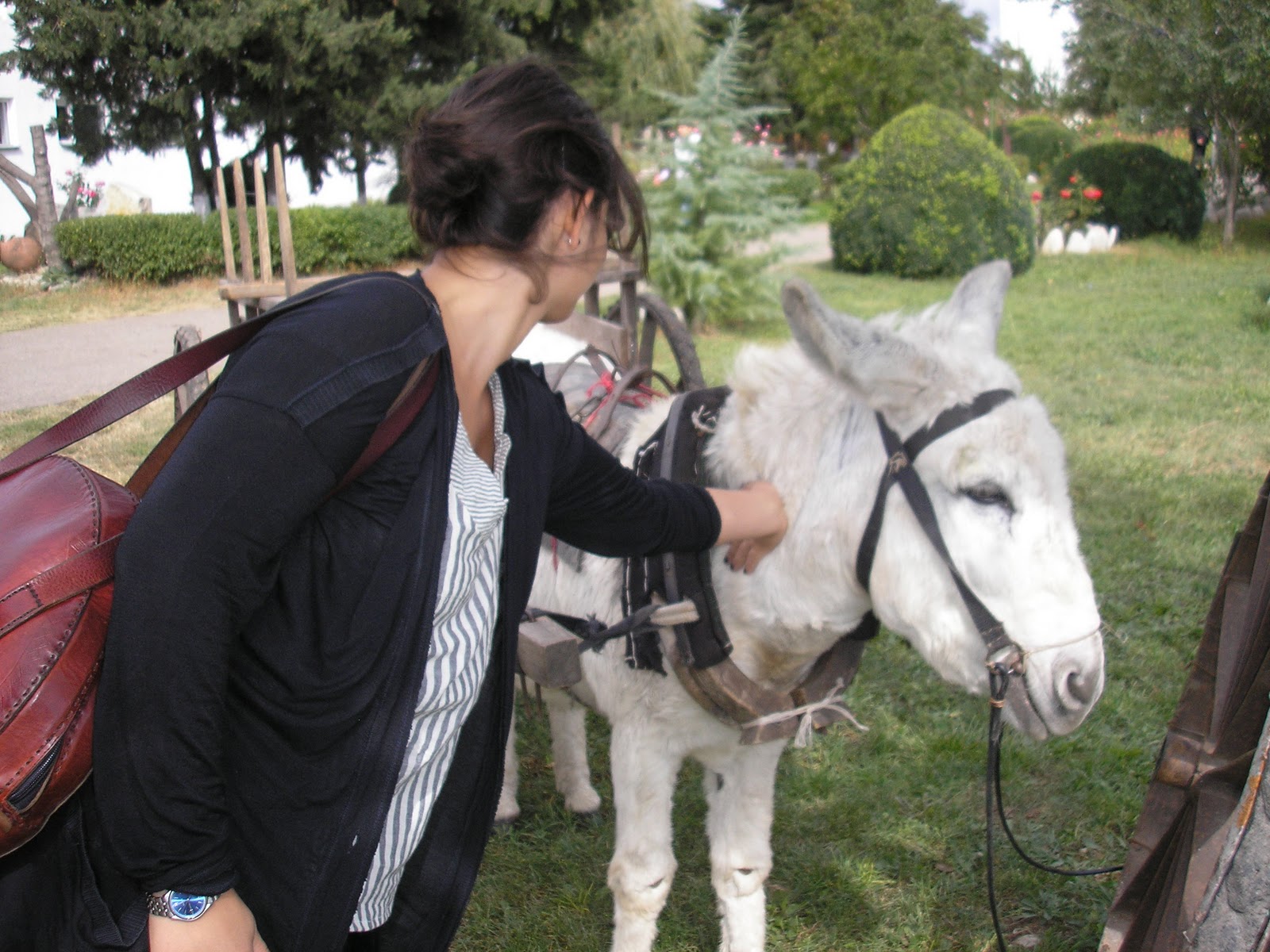
He had a little conversation with an older woman next to me. She was talking about teaching in Tbilisi when there was a bit of a lull in the conversation. He kind of looked off in the direction of the donkey, who had all of the grape baskets on his back, when Saakashvili starts telling the goofiest joke about a Kakhetian donkey on vacation as a school headmaster in Svaneti (another region of Georgia, in the mountains). It was so bizarre! But it was even funnier looking around at all the people doing the awkward obligatory laugh; that's what I was really laughing at.

So after his corny joke he moved on, shaking more hands and all that. Having felt satisfied with my handshake I stayed where I was- talking to my friends and just enjoying the sun that had just come out. We were goofing around with the grapes that were in buckets everywhere. We were taking a group picture with everyone holding a grape cluster when who walks up from behind us but Saakashvili asking if he could get in the picture too! We said, "Ooooh, okay, Misha. If you really want to be in our picture..." (or to be more accurate there was a collective, "YES! PLEASE!") How do you you turn down a president when he wants to get in your picture? It was so crazy! After that there was another swarm of people handing their cameras off to people. At one point I think Saakashvili had ten people on either side of him trying to get in.

It was such a surreal day. It wasn't so much that I was star-struck, I was just surprised that the President of Georgia was kind of a goofy guy. Especially the way the Georgians speak about him (the amount of languages they claim he knows boggles the mind. I think I've heard one report that he knows 12 different languages. Crazy stuff like that). But hearing him tell a goofy joke about a donkey and then asking us if he could be in our picture was definitely not what I was expecting.

And don't worry folks, I documented the day in pictures!


This is the security guard's feet at the front gate. There were police officers lined up and down the road for half a mile before we even arrived at the vineyard!

This is Dante the Donkey

Despite the intense security checkpoint, once we were inside we were given really large, sharp box cutters to cut the vines.

See! Large box cutter! Also, look at them grapes! I think I ate more than I picked, though. Oops.

Don't worry, Georgian Military, this isn't Saakashvili's helicopter, it's the second helicopter carrying all of his security guys with the very large guns and bullet proof vests

Dante the Donkey is a very hard worker

The picture that the president asked to be in!

Sunday, May 22, 2011

Arab Spring. Georgian Summer?

I was a bit surprised to get a warning text from the US Embassy on Friday evening. The last (and only) time I received a text from the embassy was when Osama Bin Laden had been killed. So needless to say I was more than a little intrigued by what it could be about. I was out with some people when we all got the message warning about a "planned demonstration" taking place in Tbilisi on Saturday. Saturday came and went (although the Rapture did not). I had completely forgotten about the demonstrations and I hadn't hear anything about them from facebook or my host family (my two primary sources of Georgian news). But then this evening I remembered about them. Apparently the protesters beat up a car. Here's the video from Reuters:


I have to wonder, who are these protesters and what do they want? Unfortunately I'm limited to English reports, but this well is thankfully not entirely dry. These "opposition" protesters are in opposition to the current Saakashvili administration (and my boss, to some extent). Their leader is Nino Burjanadze; she is the ex-President of the Georgian Parliament. She went to Tbilisi State University for undergrad and received her doctorate in International Law at Moscow Lomonosov State University. According to a recent television ad, or perhaps it was a very obviously biased news program (honestly I couldn't tell, it was too long to be simply a political ad, but too sinister to be a news segment. It was very strange), she is corrupt and in league with the Russians. I asked my host cousin what it was about, but only got this very vague description, so my apologies on that. But the frightening thing about what I saw of her on this television ad was the horror movie music and the cross-hairs that they put on her while showing her picture. From what I could tell the ad was not endorsed by anyone specific, but the message was clear: This woman is evil and bad for Georgia.

If this woman is so evil she must be leading protests that advocate the public murder of babies and puppies, right? No, actually what she and her party, the People's Assembly, want a reformation of the electoral system. There are eight parties, conveniently being called the group of eight, who were trying to reform the electoral system. The ruling party and the group of eight were in transparent negotiations, called the Election Code Working Group (ECWG), from November to the end of March when suddenly the group of eight pulled out of negotiations. Then on April 5 the group of eight came back with proposals, but no meetings occurred after that. On May 12 the group of eight issued a statement/ultimatum that stated they wanted a written response to the April 5 proposals before the end of May, despite the fact that in negotiations both sides had come to determine upon an autumn 2011 deadline for electoral reform negotiations to end).

So what is the opposition saying now? Well, I'll tell you that it doesn't sound non-threatening, although it doesn't sound completely threatening, either. The first protests happened on Saturday, reported number range from 6,000 to 10,000 people. The protests continued into today, Sunday.

Although these protests originated as outrage against negotiations for the reformation of the electoral system, they are quickly becoming about government oppression. The opposition is claiming that the government is oppressing the opposition parties, arresting activists, and the storming of the Batumi headquarters of the People's Assembly party (all of which the government denies). The protests are now supposed to continue into tomorrow, Monday. Nino Burjanadze said of Sunday's protest numbers that “is not enough.” According to civil.ge, she later said, "In separate remarks also on May 22 she said that that large number of people was needed in order to prevent a bloodshed as the authorities, she said, would not dare to take any actions against the protesters in case of large-scale rally." Personally, I find this to be a two-fold argument. Yes, it's true that a very large demonstration would lessen the likelihood of police brutality, however the fact that that is one of your arguments for encouraging more people to attend seems... fishy. It just doesn't seem on the up and up, for some reason, especially when you take into consideration these vague and potentially sinister remarks also given by Burjanadze, “If we are ready tomorrow we will act tomorrow… If we are ready by May 25, we will act on May 25, but it won’t be a long process; we will act in the nearest few days.” What exactly do you mean by "we will act?" And how will you define when you are "ready"?

And what is the significance of May 25, you ask? Nothing, yet. However the Georgian Party is calling for it to be “the Day of Rage of the Georgian people”, which would turn into “the last day of the Saakashvili’s regime.” And I'm sure it is no coincidence that May 26 is Georgia's Independence Day (which has me strongly rethinking this Independence Day powerpoint presentation that I just finished this afternoon. The last thing I need to set the youth of Telavi into a rebellious fervor- or maybe I'm just overestimating my skills as an educator).

The whole call for more protesters and the fact the protests are continuing two days past the original demonstration is a bit strange, and you factor in this when "we are ready" statement and it all sounds a bit foreboding. Although I don't know much about how far public opinion for the opposition spreads I can tell you that when I was watching the Reuters video, I recognized those yellow and purple flags from about two weeks ago when about five to ten cars packed with people were driving all around Telavi with those flags being held by the cars' occupants.

I'll try to keep you posted if anything else happens!

Here are the links to the articles I found. Civil.ge has been the most informative. They are in chronological order from oldest to newest:
November 28, 2009"Iron Lady Nino Burjanadze finds the steel to threaten her struggling ally," http://www.timesonline.co.uk/tol/news/world/europe/article5254306.ece
April 5, "Opposition's New Proposals on Electoral System," http://www.civil.ge/eng/article.php?id=23315
May 12, "Opposition Wants Ruling Party’s Response by End-May," http://www.civil.ge/eng/article.php?id=23435
May 12, "Ruling Party MP on Opposition's Electoral Talks Statement," http://www.civil.ge/eng/article.php?id=23437
May 22, "Some Opposition Parties Warn Against Escalation," http://www.civil.ge/eng/article.php?id=23488
May 22, "Clashes at anti-government protest in Georgia," http://www.google.com/hostednews/afp/article/ALeqM5h2cA13wWW9rZ-YxOSurs5GioVJJg?docId=CNG.cb370cb25e96ecba584d2568a4f90642.ea1
May 22,"Protest Leaders Say Rally to Remain at GPB," http://www.civil.ge/eng/article.php?id=23490

May 22, "Anti-president protests continue in Georgia; opposition calls for massive turnout Monday" http://www.google.com/hostednews/canadianpress/article/ALeqM5jckCBLqI4bAs-wUojIxOeU6NhPdw?docId=6922621

Saturday, April 23, 2011

Two Hours in a Kutaisi Police Station

On the evening of Sunday, April 17, 2011, approximately between 1900 hours and 1915 hours I lost my wallet on the street or in a minibus in Kutaisi, Georgia. It was pink. It contained 150 lari, my bank cards (American and Georgian), my health insurance cards (American and Georgian), my American driver's license, and several hundred dollars in American gift cards. I know these details quite well now because I spent two hours in a police station explaining the contents of my wallet and the events surrounding its disappearance.

I now sincerely regret going to the Kutaisi police because of a simple wallet that I will undoubtedly never see again, a fact I have now come to terms with. But upon the realization that it was gone I panicked slightly, it being the first time I had ever lost a wallet. I was in Kutaisi traveling with a friend, both of us are English teachers in the eastern part of Georgia, about a 5 hour drive away (if you are lucky enough to have your own car and not the public buses). As I was traveling and away from my town and I had never lost a wallet before I had no clue what I should do. I called up Teach and Learn with Georgia (TLG), the teaching program I work for, and they told me to go to the police. And thus began an epic endeavor that would color not only that evening, but the entirety of my three days in Kutaisi.

My friend and I arrived at the police station a little before 10 o'clock at night. There was a detective working there who spoke a little bit of English. However, to be on the safe side, I called TLG to help me translate. I gave them a description of my wallet, where I lost it, and what it contained. After hanging up with TLG the female detective who spoke English told us to sit down upstairs. It would only be another 10 or 15 minutes.

Mikhail Saakashvili, the Georgian president, has been pouring money into police departments all over the country to renovate the police stations. The aesthetic is all glass facades- a symbol of transparency. The Kutaisi police station had clearly been recently renovated- the walls and floors were all shiny white marble and you could see the pristine condition of the desks in the upstairs office. But the facade was not glass. It was the standard pink stucco of most Georgian buildings. I'm sure they didn't opt out of the glass facade in order to continue their corrupt ways or anything, don't think I'm alluding to that. Although I did find it odd to have renovated the police station top to bottom (there were before and after pictures hanging on the wall), but neglect to give it the standard Saakashvili touch.

When I went to the office upstairs I was offered a seat in a large, barren office area. There were the new desks arranged in two clusters of four. Most of them were empty, save a few papers and personal items. Definitely no computers in sight. I sat down and watched a James Bond movie that had been left on in the empty room. After 20 minutes the female detective came upstairs and I asked her if they had tried calling the other police stations to see if anyone had turned in my wallet. It had been over 3 hours since I lost it. My primary hope in going to the police in the first place was for them to contact the other stations in the city. I did not expect any crack detective work, I just wanted to see if anyone had turned it in somewhere.

About half an hour after arriving I was informed that a local English teacher would be coming to help get my statement, which I had already given to them via the TLG translator on the phone when I first arrived. My friend and I were shuffled into a smaller office. Despite the fact that the office had all of the lights off and the door had been locked, the television in there had also been left on, and it remained turned on during the entirety of my interview.

After waiting another half an hour I was introduced to a rather unsavory looking detective who's gun was rather hastily shoved into the waistband of his trousers. Although he seemed friendly enough, I got the impression that I would not want to be on the wrong side of the interview table from him. To kill time before the English translator arrived I was given the usual Georgian line of questioning, “Do you like Georgia?” “Do you like Georgian food? Khachapuri? Khinkali?” “What are you going to see while you are here?” It was our first night in Kutaisi, so I gave a list of the sights we were planning on seeing, something I would later come to regret.

The English teacher finally arrived and we went through a long hour of repeating the same basic facts. "I got my wallet out to get money while waiting for the 1 bus." "I shoved it in my bag as I saw the bus coming." "No, no one was around me at the time. No, no one saw how much money was in my wallet." "No, no one could have stuck their hand in my bag. It was on my lap the entire time." "Did someone steal it? Probably not. I don't know."

There were many times I wanted to say that if I knew exactly how I lost it I wouldn't be here in the first place. But I figured that would not be the best thing to say to these rather greasy looking detectives. Shortly before midnight I finally signed my statement-which had been entirely hand written by a yawning officer on a blank piece of computer paper. And before I left I was instructed to come back in the morning at 11 o'clock to pick up my "official documents- free of charge." I had to suppress a groan at the thought of returning to the police station. And I had to suppress a laugh at the thought of being charged for paperwork- damn right it'll be free of charge. I don't have any way of paying you, anyway.

At 10:55 the next morning I trudged my way to the station. The officer at the front desk looked at me uncomprehendingly when I tried to explain that I had been there the night before because I lost my wallet. No English. He went to find someone that could understand me. "Khuti tsuti" (5 minutes), and he raced upstairs. The person sent down to understand me also had a bit of a problem. "Please wait here five minutes." He also raced upstairs and returned with a rather tall, friendly looking man who arrived to state quite bluntly, "Our computers are down. Come back later."

"When?" I asked with a sinking feeling developing in my stomach.

The man turned to the clock behind him (11:20). "After 5 o'clock." Presumably, his shift was over at 5 o'clock.

So what more could I do but leave? By this point I was determined not to let this bother me or my trip. My friend had offered to lend me some money and it was only my first day in Kutaisi. So we went out for the day to see the sights. We returned to the city center around 7 and I had very little desire to spend another night at the police station. We returned to the apartment where we were couchsurfing. I was plenty happy to call my wallet gone for good. The police could not do anything to help, and I doubted they would even try. So why should I dedicate more time to a lost cause?

Around 11 o'clock that night my friend and I were sitting around in our guest bedroom talking, when suddenly we heard the large metal front door creaking open and someone shouting, "Chase?" (the name of our host) We heard Chase come out of his room and say, "You can't just come in, you need to knock before you come in." He said it in a rather even, if slightly irritated, tone. The intrusive speaker, who I would find out later was Chase's landlord, mumbled something of which the only word I could understand was "police." I let out a groan and hauled myself into the living room. The detective from the night before (the one with the gun shoved into his waistband) was standing in the middle of the room, looking like he owned the place- and rightfully so, as his wide girth seemed to make the room look smaller.

"You did not come to the police station today," Chase's landlord said.

"Yes, I did," I stated, without doing much to veil my exasperation. "I came at 11 o'clock. They said their computers were down."

"They need your passport. You must come."

"Now?" I piped in a high pitched tone.

He conversed with the detective in Georgian for a second and responded, "No, you may come tomorrow morning at 11."

"Fine."

They left and the apartment felt bigger again. Safer. I apologized profusely to Chase, whom I had only met the day before and who's kindness I was dependent upon for my housing. My mother has always told me to never trust the police. She was a public defense attorney in one of the roughest neighborhoods in Boston. Her voice was running through my head the entire time I was at the police station. They wanted to know where I was staying in Kutaisi. As I said, I was couchsurfing with this guy. He did not have to let me stay there, and considering that the police barged into his apartment looking for me I'm surprised he didn't kick me out then and there. The police had my phone number. If they really needed to find me they could have easily called me. But instead they walked into someone's house without permission and without even knocking. I realized that I had no choice but to deal with them, no matter how much I just wanted to forget about the whole ordeal.

Once again, at 11 o'clock the next morning I found myself back at the police station. This time their computers were working and the English speaking female detective was there. After having my passport xeroxed and receiving 7 copies of the same piece of paper without any explanation of what these paper were for- they were entirely in Georgian, save my name- I thought I was free to leave. But the female detective asked where my friend and I were going that day. We wanted to go out of town to the Sataplia caves.

"Yes. We will have a police officer drive you," she responded.

"No, no. That is alright. We are going to get a taxi. We do not need a police officer." But there was no point in arguing. We were getting a police officer to drive us. We were also instructed to come back to the police station the next morning, the morning of our departure to Tbilisi, in order to get a ride from the police to the bus station.

We were handed over to a police officer in uniform and a plain clothes detective (with a gun sticking out of his waistband). We got into a large SUV with no sign that it was a police vehicle other than a siren attached to it somewhere (which they used to break up the line at the gas station). The SUV took us to the edge of town where they pulled over to the side of the road next to a waiting taxi. The uniformed officer got out and spoke to the cab driver, then returned to open my door and repeat, "Sataplia, Sataplia." I have no idea why we needed to go so far just to be put into a cab. Maybe it was cheaper away from the city center? Maybe the police officer knew this driver? I have no clue. Due to the language barrier, most of my interactions with the Kutaisi Police Department went unexplained.

The next morning I prepared a note for the English speaking female detective explaining we had left for Tbilisi. My friend and I could not be bothered to go through a whole ordeal of getting a ride from the police again. So I wrote the note in the hopes that the detective was not working and I would be able to escape the city unnoticed. This was the one time I was glad not to find someone who spoke English. I went to the officer at the front desk, handed him the note and said the detective's name. The officer told me she would not be in until 10. I tried to convey that it was okay- "Kargi. Kargi" (Good. Good). He started to get his phone out, clearly with the intent of calling her. And I said, "No, no." and mimed him giving her the letter. Eventually he got it and I left quickly.

I can not help but think that all of my interactions with the police in Kutaisi were so absurd and quite unnecessary. The first night did not need to last as long as it did, and the succeeding days did not really require a daily trip to the police station. Every day I was in Kutaisi I went to the police station once. I'm sure all of this transpired because of two factors- the language barrier and the fact that I am a foreigner. Because of the language barrier everything took longer and there were miscommunications. Because I was a foreigner they were clearly going out of their way for me. I'm sure most Georgians would not go to the police if they lost their wallet, which would probably explain the fact that it took them two hours to get my written statement together. And I know that if a Georgian were in the same position as I had been in, they probably would not offer them rides around town. I don't know if this was the famous Georgian hospitality kicking in, or if their hope was to impress me, but whatever the reason I was disgusted with the whole affair.

Saakashvili considers his reforms of the Georgian police to be his most major achievement. Of his reforms he has said, “Together with you [police officers], we have created one of the most successful, one of the most well-equipped, one of the most efficient police force in the country, where the reputation of police was extremely bad just several years ago.” (Civil Georgia, 'Saakashvili Hails Georgian Police as "Most Efficient,"' 24 June, 2006 <http://www.civil.ge/eng/article.php?id=12906>) I wish I could say I agree with him. It is clear the Saakashvili administration has put a lot of money into the police force, but from my experience this money appears to be going towards making things look nice, but not improving the roots of the problems. Saakashvili claims the police are "well-equipped." I saw only one computer at the station in Kutaisi. Saakashvili says they are efficient. The officer taking my statement did not know what to do- his supervisor had to dictate everything to him, while several other detectives sat around watching television. If I have witnessed the result of years worth of reform, I am truly afraid to think about the state of the Georgian police ten years ago.

Wednesday, April 6, 2011

Tourist for Hire

I received an interesting phone call today from TLG, the government program that I am working for. They were calling to let me know that they offering an excursion for volunteers this weekend which was leaving from Telavi, the town I live in. Alexander, the friendly Georgian in charge of these excursions, wanted to know if I was interested in joining this all expenses paid, one day excursion. Unfortunately, I had already made plans for the weekend. Alexander seemed a little disappointed, but assured me there was another free excursion next Sunday and he promised to e-mail me the information.

Alexander's call was very informative and I appreciated his effort to inform me of this complementary outing. But at the same time the call reminded me of a telemarketer calling to let me know about a free weekend at a ski resort, if I would only agree to an hour long informational session, or a free lunch for anyone interested in a real deal of a cruise package! But, no. Of course these excursions aren't gimmicks to get me to buy something... Or are they?

The teaching program I'm on is called TLG, Teach and Learn with Georgia. It is run by the Georgian Ministry of Education and its objective is to bring native English speakers into Georgian public schools and teach English alongside a Georgian English teacher. At its heart it is an educational program. But I can't seem to shake this nagging feeling that it is also some greater tourism ploy. And this suspicion is not unfounded. From the outset TLG has strongly encouraged us "volunteers" (because we are technically, legally, and contractually called volunteers, an irony that I will reveal later) to travel around Georgia. Although TLG is an educational program, it is also a cultural interchange program. We live with host families- which, as you may have inferred from my previous blogs, is a whole lot of cultural interchange. As a result of living with host families we get to know the culture of the area we are living in. TLG also encourages us to visit fellow TLG'ers around the country, which offers a chance to learn more about the cultures in different areas; and in a country that's only the size of South Carolina, there are actually significant differences between the regions. (Me? I'm in the region known for its traditional values and aversion to social change. Great.)

It is not surprising that TLG encourages us to travel. Most of us are under 30 and if we're willing to take a job in the tiny, little known country of Georgia than chances are we are a group of people not averse to travel. But what I was surprised by was just how emphatic they are about getting us to travel around the country. In order for TLG "volunteers" to be able to travel around we are actually paid more per month than our Georgian co-teachers. Yes, you read that right. We get paid more than our co- teachers who do this thanklessly day in and day out. And it is not a small difference. Volunteers working for TLG get paid 500 lari after taxes every month. The average Georgian schoolteacher gets paid 100-200 lari per month. This is an awkwardly huge discrepancy that I am often embarrassed of when people ask me what I get paid. And Georgians do ask what we get paid, often. I have met people and within five minutes of being introduced they have asked me what I get paid. The extra salary is not going toward our savings for flights back home, either. TLG pays for our flights to and from Georgia, including summer vacation. During our week-long orientation the TLG staff was quite open about the fact that we get paid this extra amount in order for us to travel around Georgia, and in part to compensate for some of the situations that people might be placed in. In a country where a kilo of fruit or vegetables might cost as little as 3 lari, 500 lari goes a long way.

So why the expense? It's not like the Ministry of Education and Science couldn't use the money somewhere else, like making sure every school has heat and electricity, basic supplies for schools such as chalk and proper chalk boards, repairing the rooms that simply can't be used because the floors have been torn up and the windows have been broken. The list could go on. Perhaps the government hopes that by bringing enough foreigners into this tiny Caucasian country- they're goal is to have 1,000 volunteers by the end of the school year- that word will spread about what a wonderful vacation spot Georgia is. After all, when the program started they placed volunteers in the west of Georgia, on the Black Sea. I don't know how familiar you are with Soviet-era vacation spots, but let's just say Moscow is still green with envy that they don't have easy access to Batumi any more. The program has been moving eastward. My group, which arrived in January was the first to be placed in the Kakheti region, the last region in the east of the country. Despite the fact that the TLG program is being run out of Tbilisi, Georgia's capital and about an hour and a half car ride from Telavi, they started placing people in the west. The west of Georgia not only has beautiful beaches but it is also a lot more socially progressive. And it is in Batumi, the biggest town in the west, that Donald Trump will have another tower in his name. This latest mammoth of gambling and western "culture" (any dictionary with a definition of culture including Donald Trump should be sent back to the editor) is the product of a friendship between Mikheil Saakashvili, the Georgian president, and Donald Trump himself. Clearly, the president has high hopes for Batumi to become the latest summer hot spot.

I might be thinking about this too much, but I simply can't shake the feeling that this is all part of a greater desire by the Georgian government to propel itself back to the "first world" or the "developed world" (which ever term is no longer politically incorrect). I had a conversation with a Georgian man not much older than myself today and he told me that Georgia used to look at countries like India and Pakistan (those were his countries of choice, not mine) and think how nice it was to not be in the third world. But now Georgia is behind. After independence in 1991 Georgia went through a few civil wars, which left a majority of the nation without electricity, even Tbilisi had regulated blackouts at night. This electricity crisis lasted several years. It was probably this period that caused Georgia to slip "out of the top." As other countries in the world were quite literally powering forward- advancing technology, incorporating computers into daily life, developing this little thing called the world wide web- Georgia didn't have any power. And to this day there are stop lights in Telavi that have not worked since Georgia became an independent country. If there are any Georgian political experts in the audience, please correct me if I'm wrong with this theoretical summary of modern Georgian history. Don't get me wrong, I'm not saying that is is a bad thing for a country to want to improve its status in the world and bring in foreign investments, but I do want them to be up front about it. If I'm being used to promote Georgia, just give me a heads up, and maybe a bumper sticker or something. However, before Georgia uses all of this energy and money, they should sit down with a mirror and see what needs to be fixed internally before they focus on external opinion.

Perhaps the Georgian government hopes that these several hundred volunteers will spread the word about this sleepy little country with high hopes. Perhaps I am simply a pawn, part of some plan thought of during some governmental financial planning meeting. All I know is that no matter what ulterior motives may lie behind my being here, I am here. And I will enjoy my time here while I have it, even if I am playing right into their hands...