Showing posts with label Republic of Georgia. Show all posts

Wednesday, October 5, 2011

"It's Nice to Meet You, Mr. President"

So, I haven't posted in a while. There have been a lot of things going on. School started. My host family punished their daughter by taking the internet away (and she didn't even know that that was her punishment. Very effective, eh?). Living in Tbilisi is a lot different than Telavi. And I was going to write about all of these things. But one event eclipsed all of those! I met Misha Saakashvili himself! The President of Georgia! How do you like that?!

It happened this past Saturday. TLG offers excursions for the teachers; basically they take us out to do something traditionally Georgian, or just to see more of Georgia. About two weeks ago they took 200 people living in Tbilisi on an overnight stay in Batumi to see an opera. Yours truly was not able to go because I didn't sign up in time. But it's that sort of thing- all paid for, transportation included, you get fed. Pretty good deal. So this weekend was an excursion to pick grapes in Kakheti- the region of Georgia most known for it's wine and also where I was living last semester. I signed up thinking it would be a nice thing to do on a Saturday. But a few days later I found out that the president was going to be there! I was incredibly surprised because he had been at the opera in Batumi and he had been to another excursion the week before. Nonetheless, it was still exciting!

Saturday got off to a cold and blustery start. We had to meet for the bus at the Radisson Hotel here in Tbilisi at 9am. One thing Georgia doesn't seem to be big on is transitional seasons. A few days earlier it had been in the upper 70s, but Saturday morning was down in the mid-50s and the wind cut through my thin blazer so easily. They had us waiting outside the buses for a good 45 minutes in the cold. No idea why; we were looking at the buses, but we still had to wait outside. By the time we arrived in Katchreti, the vineyard school where we would be picking the grapes, everyone was kind of cold and grumpy. It didn't help matters that we had to wait around for another half hour just to pick the grapes. The morning was pretty unorganized. But everything got very organized very quickly when the president's helicopter got in sight. The security guys, who had been there the whole time, suddenly started walking around, telling people where to go. We weren't even allowed to take pictures of the helicopter as it landed.

Once Saakashvili was on the ground there was a huge group of people that flocked to him. Not being one for large groups I kind of stood off to the side. Close enough to see him, but without getting mixed up in the crush of people. As luck would have it he started making his way past the rows of grapes, shaking hands and saying hello. He wandered in my direction and I was able to shake his hand. I even said, "It's nice to meet you, Mr. President." First time I've ever been able to say that!

He had a little conversation with an older woman next to me. She was talking about teaching in Tbilisi when there was a bit of a lull in the conversation. He kind of looked off in the direction of the donkey, who had all of the grape baskets on his back, when Saakashvili starts telling the goofiest joke about a Kakhetian donkey on vacation as a school headmaster in Svaneti (another region of Georgia, in the mountains). It was so bizarre! But it was even funnier looking around at all the people doing the awkward obligatory laugh; that's what I was really laughing at.

So after his corny joke he moved on, shaking more hands and all that. Having felt satisfied with my handshake I stayed where I was- talking to my friends and just enjoying the sun that had just come out. We were goofing around with the grapes that were in buckets everywhere. We were taking a group picture with everyone holding a grape cluster when who walks up from behind us but Saakashvili asking if he could get in the picture too! We said, "Ooooh, okay, Misha. If you really want to be in our picture..." (or to be more accurate there was a collective, "YES! PLEASE!") How do you you turn down a president when he wants to get in your picture? It was so crazy! After that there was another swarm of people handing their cameras off to people. At one point I think Saakashvili had ten people on either side of him trying to get in.

It was such a surreal day. It wasn't so much that I was star-struck, I was just surprised that the President of Georgia was kind of a goofy guy. Especially the way the Georgians speak about him (the amount of languages they claim he knows boggles the mind. I think I've heard one report that he knows 12 different languages. Crazy stuff like that). But hearing him tell a goofy joke about a donkey and then asking us if he could be in our picture was definitely not what I was expecting.

And don't worry folks, I documented the day in pictures!


This is the security guard's feet at the front gate. There were police officers lined up and down the road for half a mile before we even arrived at the vineyard!

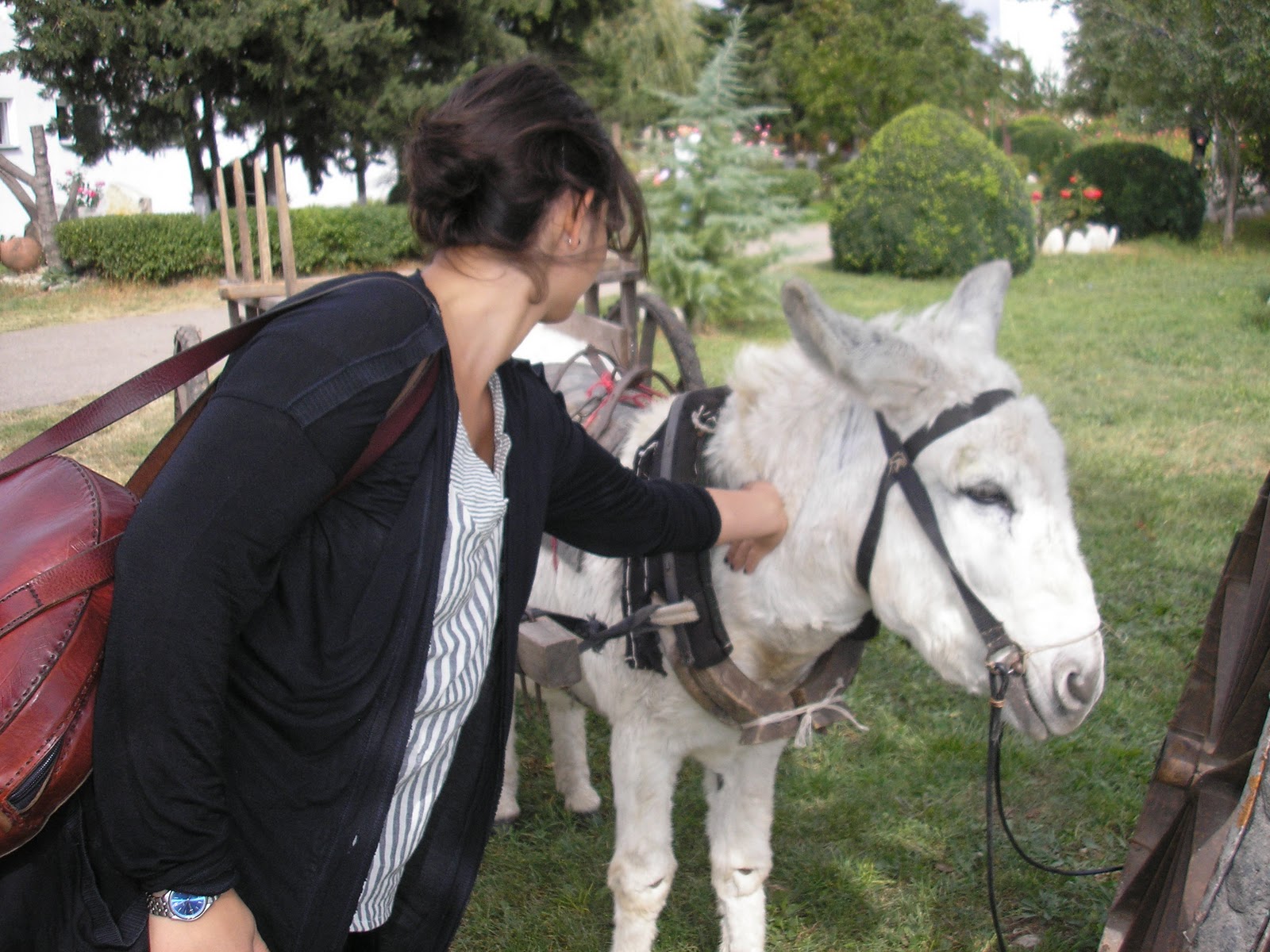
This is Dante the Donkey

Despite the intense security checkpoint, once we were inside we were given really large, sharp box cutters to cut the vines.

See! Large box cutter! Also, look at them grapes! I think I ate more than I picked, though. Oops.

Don't worry, Georgian Military, this isn't Saakashvili's helicopter, it's the second helicopter carrying all of his security guys with the very large guns and bullet proof vests

Dante the Donkey is a very hard worker

The picture that the president asked to be in!

Sunday, September 18, 2011

Oh my бог!

I don't think I've ever felt more American than I did this past week. It's not because it was the 10th anniversary of 9/11. And it wasn't because I stick out like a sore thumb around these parts as being significantly not Georgian. Nope, it's all because I had the most American evening in my entire life.

It started in pretty typical Georgian flair- the sisters decided we were going to the movies so off we went, without checking the movie times or what was playing. (because why would you plan ahead when you could just GO?) We arrived at the movie theater and had to wait around for over an hour to watch what we thought was a Russian-dubbed version of that really bad shark movie. You know, that one that recently came out. It's about the group of college kids on vacation who find trouble and have to run around while hardly wearing any clothes. Basically, it's I Know What You Did Last Summer, except with sharks instead of a psycho killer. I figured I would just roll with it because that type of movie isn't really dialogue-heavy anyway (a scream in English is a scream in Russian is a scream in Georgian, etc., etc.) It turned out that the movie was actually The Hangover II. Don't know how that mix-up happened, but I was still in the 'I'll roll with it, sure thing' mood. It was still in Russian, though. And even though it was dubbed in Russian and I was the only one who laughed when Mike Tyson made an appearance (because I was the only one who knew who Mike Tyson is), I felt oddly American. I think what really did it for me was the coke. You see, I don't drink coke. I'm not a huge fan of soda in general and coke leaves an overly sweet and vaguely metallic taste in my mouth. But you know, I was just so thirsty and my host sister had bought the thing for me that I just went with it. And sitting there with my popcorn and coke, I just felt American.

And the American tour of Tbilisi didn't stop there. After the movie the sisters took me to McDonald's. For some reason instead of walking to the McDonald's, their dad picked us up in his large SUV and drove us the two block's to McDonald's- if that isn't American, I don't know what is. And looking around at the McDonald's clientele, I couldn't help but notice the overwhelming amount amount of American logos on t-shirts and jeans and handbags. And if a t-shirt didn't have a logo on it, it would have something in English.

It seemed so strange, almost too American. It funny, you don't realize just how America is portrayed through TV and movies until you see people trying to imitate that. When most Americans look at shows like My Super Sweet Sixteen and The Kardashians we realize that it is more fantasy than reality TV. The percentage of people who live like that is very small. But that rationale really gets lost in translation when these images are broadcast all over the world. When a young Georgian sees these images what else are they to think other than, "Wow, that's how Americans live." And unless people actually go to America and see for themselves that we are not how our television represents us, it is pretty hard to crack the veneer of their image of America.


P.S.-The title of this post is one of the Great Moments in Dubbing History. In the Hangover there's one point where one of the characters does a very slow and shocked, "Oh. My. God." For some reason the Russian dubbers decided to say, "Oh. My." in English, but then just said the Russian word for God [pronounced bog]. I was the only one in the theater who seemed to find that incongruity hilarious...

Sunday, September 11, 2011

If You Ever See an On-Coming Georgian Wedding- DUCK. AND. COVER.

So I wasn't in Georgia more than half an hour and I got invited to a Georgian wedding! I had been expecting to go to a Georgian wedding last June. It was my fluent English-speaking host cousin's wedding. I had helped her with a bunch of her English classes at the university and we got along really well, but I didn't get an invite to her wedding... But hey, that's cool. I'm not bitter... much. (No seriously, I'm not bitter. I think it may have been a culture confusion mix-up. I never received a formal invite, but that's because Georgia doesn't have a formal mail system. So everything is done by phone. And I'm still not sure if it's common custom that I am part of the family, therefore I am obviously invited. Or I was snubbed. I'm not bitter, just confused.)

The wedding was for my host father's nephew. I was told it was on the 8th, but no one really gave me an exact time. First it was at 12, then it was at 3, then it was at 2. Then it was 1 o'clock and I was told we were going. Thankfully I had the foresight to get dressed early because I know how these Georgians are kind of liberal with their times. And as it turned out, all of the times I was given were correct. And how can this be? you ask. Well, apparently a Georgian wedding is a multifaceted event (or at least, this wedding was multi-faceted). So here's the run down...

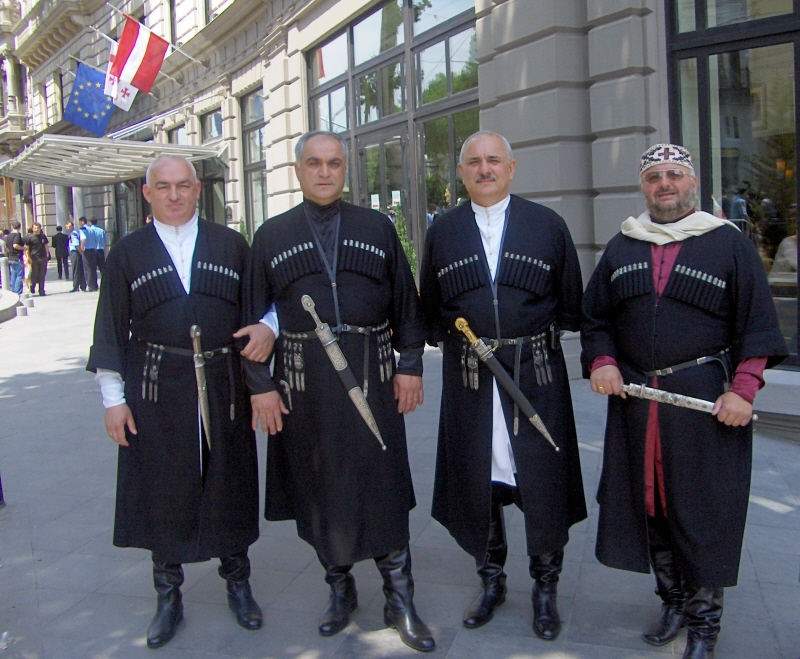
First, the family of the groom all met at his house for some light toasting. There were a couple of champagne glasses that made the rounds for all the people in the groom's family. When it was a person's turn to toast they were given one of the glasses, made their toast, and the toaster, groom and groomsmen all drank. So basically it all sounded like an elaborate rouse to get the groom drunk (but that's just my take on the matter). And the groom and a couple of his groomsmen were wearing traditional Georgian dress. It basically looks like a Cossack, but without the hat. (Here's just a picture of the traditional outfit I found on google), but the bride was wearing a very modern white dress.

From there everyone piled into their cars and we drove to the bride's house where her family has been doing the same thing. Now this is the thing you should take away from this blog: If you ever see an on-coming Georgian wedding- DUCK! AND! COVER! (It's in the title. I can't emphasize this point enough, people!) When they all pile into their cars it's basically a giant race to catch up to the limo, and the limo drives like it's a race to get to the wedding first. Everyone is bobbing and weaving through traffic, cars are slipping between each other, driving on the wrong side of the road. It's madness. And I was in the car with the guy videotaping the whole shebang. So not only were we bobbing and weaving, we were also skidding 180s around corners so he could get footage of the whole car procession. At one point we drove right up alongside the limo nearly taking off the side mirrors of both cars!

So after we picked up the bride we went to the church. And this was one of the odd parts. We spent a good half hour milling around the church, which is very easy to do because Georgian Orthodox churches don't have any pews. If you've ever seen a Russian Orthodox church it's basically the same aesthetic- no pews, frescoes of saints and Jesus, candle holders, icons. At one point I thought the wedding began because I heard the wedding march, but it just turned out to be someone's ringtone on their cell phone. Finally the priest showed up and the wedding commenced. And maybe I could have appreciated it more if I spoke fluent Georgian, but I don't, therefore the entire hour of the priest chanting was kind of lost on me. But it seemed that I wasn't alone because throughout the ceremony people kept on walking around the church, chatting with each other. At any given point during the ceremony half the wedding party was outside in the church courtyard. And a couple of times my host sister asked if I wanted to go sit down outside. All in all, everyone seemed a wee bit underwhelmed by the whole ceremony. Not a tear was shed.

After the church ceremony we piled into the cars again and began the mad dash to what I assumed was the party (and I was starving by this time, so I sincerely hoped it was the party). And we pulled up to a big restaurant-looking building. Once again we milled around in the big marble lobby for a bit. Pictures were taken by all. My host sister told me it would be a ceremony with dancing, which I assumed to mean party. But it was, in fact, another ceremony. We were all brought into this very, very pink room with some large mirrors on the walls (that all of the women flocked to and checked their makeup). There was a little stage in the middle of the room with a podium to the back of it. A woman, wearing what looked like a waitress outfit of a plain white button-down and a black skirt, turned on a very loud rendition of the wedding march and the bride and groom walked in arm-in-arm. They stepped up on the podium where the waitress-looking woman said a few words and the bride and groom signed their marriage contract. This whole ceremony felt so contrived. It looked more like some drive-by Vegas wedding than an actual ceremony. And yet people were getting tear eyed! After they signed their contract the woman switched the CD player to some corny overly romantic song and the bride and groom had their first dance as one of the bridesmaids went up to a second level of the room and sprinkled large silver confetti on them. Now I thought that this was maybe a little thing that the restaurant did and from there we would go into the room where the party would be. But nope, this was the whole purpose of this stop.

So back in the cars we all piled and off to Sameba Cathedral (here's the wiki page for it). This is the big cathedral in Tbilisi. And I must say, it is quite impressive. Just walking up to it is amazing. The marble walkway from the entrance gates up to the church steps is simply gorgeous. It almost makes you feel like you're walking on water. And there are gardens, which I only saw a small portion of. I would love to go back some time just to spend a leisurely afternoon and really enjoy it. And also take plenty of pictures. Being there really made me wish that I had a nice camera.

Finally we got to the party! As far as American wedding ceremonies go, I would say it was fairly similar. Except the songs were all in Georgian (except for one heavily Georgian-accented Spanish rendition of Shakira's 'This Time for Africa'), and the toasting was also in the Georgian style of no one drinks the wine unless there has been a toast made by the tamada (the 'toast master'). Oh and there was food. So much food. By the end of the night we were five layers deep in food because they just kept piling the serving plates on top of the last one- even though all the plates still had food on them! The food was very Georgian. And my host father's brother (I think that's who he was), kept piling food on my plate and he wouldn't let me pour my glass, even when I was pouring water! He would take the bottle out of my hand and our the rest himself, despite the fact that it was almost full anyway. That did start to bother me. I like to be a very hydrated individual (which is weird for Georgians because they never drink water), so I was refilling my water a lot. But he refused to let me do it myself!

Another difference with the songs was also that occasionally they would do a traditional song that required the traditional dancing, which I have only the vaguest idea of what to do. So I did not dare go out on the dance floor when I saw people's hands start doing the little twirly motions. The dance floor is also a dangerous place when they are doing the traditional dances- there is a lot of leaping and jumping involved. I'm not very well coordinated on a good day. But when there are people running and leaping around me, I know it'll end poorly for all parties involved.

A random cultural thing I noticed was that it doesn't seem improper for other women to wear to wear white! I saw the first woman in white and thought, "Oh, that's in poor taste." But then a couple other women were wearing white, too, so it must not be an issue.

Well, folks, that was my Georgian wedding experience! If you ever get a chance to go to a Georgian wedding definitely grab it. Just be well hydrated and maybe have a snack on hand.

Friday, September 9, 2011

New Semester, New Blog!

Well, okay, it's not a completely new blog. But it's got a new name! "How to Eat Khinkali: And Other Tidbits for the Georgian Traveler." What do you think? Sound good?

Well, I've finally arrived! It was quite the horrible trip to get here. All in all it took 32 hours of travel to get from Boston to Tbilisi. A majority of which was spent waiting around in airports. And after all of that I still didn't finish my book! Would you believe that!

And along with my new semester is a new host family. I was expecting to get an apartment in Tbilisi this semester, but it is really difficult to rent if you're only here for 4 months; I know that's the case in the U.S., but I kind of figured they might be a bit more lax about it here. Oh well. The new host fam is pretty cool. There's a 15 year old girl, Mari, who'll be my student at at school. And then there is an 18 year old girl, Irina, who is married! Jeez! She's married! And she's been married for a year!! When I told the two sisters I was 23 they gasped like I had one foot in the grave. Jeez. I forgot how much of a tipsy-turvy place Georgia can be. The new house is definitely a lot nicer than my old host family's house. This house was re-built 7 years ago. I would say the only drawback is that the shower is across the alley from the house. On the drive from the airport Mari was telling me that they live in an "Italian yard." I expected that to be a courtyard. But no, they live in an alley. Granted it's a very nice alley. They seem to know all of their neighbors very well and it's quiet because there aren't any cars driving by. But I would not call it an "Italian yard." Thankfully it's not a large "Italian yard" and the shower isn't far away. I don't quite know how to describe the shower room. It's not just for a shower. It's sort of like... a basement! Yes, it's like a basement across the street. And in this "basement" there is not only the shower but also a washing machine and a tread mill! Yes, that's right folks, a tread mill! Gone are the days of paying 30 lari a month to go use the tread mill at the Telavi Tennis Courts! A free tread mill!

My new place has some definite perks. Although living in Tbilisi definitely has a much different feel than Telavi.  The people here seem a lot more preoccupied with appearances. The same can be said of any big city, but I didn't expect the discrepancy to be so marked. Although, to be fair, I am basing this assumption on the wedding I attended last night (don't worry, I'm planning a whole other post about it!). And everyone gets tarted up for weddings (except me, evidently. I didn't bring any super wedding-worthy clothes. Oops). Perhaps I'll end up having to succumb to the Tbilisi fashion and get me a pair of 5 inch toothpick-thin stilletoes, a couple pounds of make-up, and a brightly colored shirt with excessive bows and frills.

Or not.


More to come! Stay tuned! It's a whole new semester with all new adventures!

Monday, June 13, 2011

Winding Down

The last day of school is Wednesday. That's in two days! Oh my! But since there are only two days left, of course I haven't had any students showing up for the past week. I mean, even the last two weeks have been comprised of skeleton classes. Mostly it's just the smart kids who care. But I wasn't able to take advantage of that because the teachers had them doing tests mostly. And then last week happened and whole classes stopped showing up entirely. In my seventh grade last Thursday there was one girl. I taught her how to make paper cranes.

Now I'm not exactly surprised that kids have stopped showing up. The four and a half months I've been here have illustrated that no one seems to be a stickler for classroom attendance. But today I had an interaction with a student that just absolutely floored me. I honestly wanted to burst out laughing in this girl's face. About 2 weeks ago a girl in my 9th grade class asked if I could tell her about American slang. I was a little hesitant because this girl's English isn't very good. I'd much rather her practice vocab and grammar. I also feel like people sound so dumb when they speak slang in other languages. I have images of the old SNL sketch with Dan Aykroyd and Steve Martin flash through my head- "We are two wild and crazy guys!" But I talked it over with another volunteer and decided that it might be a good class activity. This was two weeks ago. This girl that asked me to do this hasn't shown up to class once in those two weeks, but she's had no problem stopping me in the hall and asking if I'll give her something on slang. And when she asks I say, "Next class." So today I was sitting in the teacher's room and this girl came by to speak to another teacher and on her way out she came over and asked if I could give her something on slang tomorrow. I said, "Yes, we have class tomorrow I'll give it to you then." And she then proceeded to crinkle her nose and say, "But we class in the 5th period tomorrow and I don't want to stay." This student actually told me that she just didn't want to stay for class! After asking me for two weeks to do something for her, it's really such a hassle to stay in school until 1 in the afternoon?

I have some slang for you: Ballsy.

Holding back my astonishment/annoyance I sternly told her, "Too bad. We are still in school and you are supposed to go to class. So if you want this you'll have to come to class." I can't even imagine ever saying that to a teacher in the U.S. Wow.

I'll be back in Boston in about a week and a half. I can't wait to get a break from Georgia.

Wednesday, April 6, 2011

Tourist for Hire

I received an interesting phone call today from TLG, the government program that I am working for. They were calling to let me know that they offering an excursion for volunteers this weekend which was leaving from Telavi, the town I live in. Alexander, the friendly Georgian in charge of these excursions, wanted to know if I was interested in joining this all expenses paid, one day excursion. Unfortunately, I had already made plans for the weekend. Alexander seemed a little disappointed, but assured me there was another free excursion next Sunday and he promised to e-mail me the information.

Alexander's call was very informative and I appreciated his effort to inform me of this complementary outing. But at the same time the call reminded me of a telemarketer calling to let me know about a free weekend at a ski resort, if I would only agree to an hour long informational session, or a free lunch for anyone interested in a real deal of a cruise package! But, no. Of course these excursions aren't gimmicks to get me to buy something... Or are they?

The teaching program I'm on is called TLG, Teach and Learn with Georgia. It is run by the Georgian Ministry of Education and its objective is to bring native English speakers into Georgian public schools and teach English alongside a Georgian English teacher. At its heart it is an educational program. But I can't seem to shake this nagging feeling that it is also some greater tourism ploy. And this suspicion is not unfounded. From the outset TLG has strongly encouraged us "volunteers" (because we are technically, legally, and contractually called volunteers, an irony that I will reveal later) to travel around Georgia. Although TLG is an educational program, it is also a cultural interchange program. We live with host families- which, as you may have inferred from my previous blogs, is a whole lot of cultural interchange. As a result of living with host families we get to know the culture of the area we are living in. TLG also encourages us to visit fellow TLG'ers around the country, which offers a chance to learn more about the cultures in different areas; and in a country that's only the size of South Carolina, there are actually significant differences between the regions. (Me? I'm in the region known for its traditional values and aversion to social change. Great.)

It is not surprising that TLG encourages us to travel. Most of us are under 30 and if we're willing to take a job in the tiny, little known country of Georgia than chances are we are a group of people not averse to travel. But what I was surprised by was just how emphatic they are about getting us to travel around the country. In order for TLG "volunteers" to be able to travel around we are actually paid more per month than our Georgian co-teachers. Yes, you read that right. We get paid more than our co- teachers who do this thanklessly day in and day out. And it is not a small difference. Volunteers working for TLG get paid 500 lari after taxes every month. The average Georgian schoolteacher gets paid 100-200 lari per month. This is an awkwardly huge discrepancy that I am often embarrassed of when people ask me what I get paid. And Georgians do ask what we get paid, often. I have met people and within five minutes of being introduced they have asked me what I get paid. The extra salary is not going toward our savings for flights back home, either. TLG pays for our flights to and from Georgia, including summer vacation. During our week-long orientation the TLG staff was quite open about the fact that we get paid this extra amount in order for us to travel around Georgia, and in part to compensate for some of the situations that people might be placed in. In a country where a kilo of fruit or vegetables might cost as little as 3 lari, 500 lari goes a long way.

So why the expense? It's not like the Ministry of Education and Science couldn't use the money somewhere else, like making sure every school has heat and electricity, basic supplies for schools such as chalk and proper chalk boards, repairing the rooms that simply can't be used because the floors have been torn up and the windows have been broken. The list could go on. Perhaps the government hopes that by bringing enough foreigners into this tiny Caucasian country- they're goal is to have 1,000 volunteers by the end of the school year- that word will spread about what a wonderful vacation spot Georgia is. After all, when the program started they placed volunteers in the west of Georgia, on the Black Sea. I don't know how familiar you are with Soviet-era vacation spots, but let's just say Moscow is still green with envy that they don't have easy access to Batumi any more. The program has been moving eastward. My group, which arrived in January was the first to be placed in the Kakheti region, the last region in the east of the country. Despite the fact that the TLG program is being run out of Tbilisi, Georgia's capital and about an hour and a half car ride from Telavi, they started placing people in the west. The west of Georgia not only has beautiful beaches but it is also a lot more socially progressive. And it is in Batumi, the biggest town in the west, that Donald Trump will have another tower in his name. This latest mammoth of gambling and western "culture" (any dictionary with a definition of culture including Donald Trump should be sent back to the editor) is the product of a friendship between Mikheil Saakashvili, the Georgian president, and Donald Trump himself. Clearly, the president has high hopes for Batumi to become the latest summer hot spot.

I might be thinking about this too much, but I simply can't shake the feeling that this is all part of a greater desire by the Georgian government to propel itself back to the "first world" or the "developed world" (which ever term is no longer politically incorrect). I had a conversation with a Georgian man not much older than myself today and he told me that Georgia used to look at countries like India and Pakistan (those were his countries of choice, not mine) and think how nice it was to not be in the third world. But now Georgia is behind. After independence in 1991 Georgia went through a few civil wars, which left a majority of the nation without electricity, even Tbilisi had regulated blackouts at night. This electricity crisis lasted several years. It was probably this period that caused Georgia to slip "out of the top." As other countries in the world were quite literally powering forward- advancing technology, incorporating computers into daily life, developing this little thing called the world wide web- Georgia didn't have any power. And to this day there are stop lights in Telavi that have not worked since Georgia became an independent country. If there are any Georgian political experts in the audience, please correct me if I'm wrong with this theoretical summary of modern Georgian history. Don't get me wrong, I'm not saying that is is a bad thing for a country to want to improve its status in the world and bring in foreign investments, but I do want them to be up front about it. If I'm being used to promote Georgia, just give me a heads up, and maybe a bumper sticker or something. However, before Georgia uses all of this energy and money, they should sit down with a mirror and see what needs to be fixed internally before they focus on external opinion.

Perhaps the Georgian government hopes that these several hundred volunteers will spread the word about this sleepy little country with high hopes. Perhaps I am simply a pawn, part of some plan thought of during some governmental financial planning meeting. All I know is that no matter what ulterior motives may lie behind my being here, I am here. And I will enjoy my time here while I have it, even if I am playing right into their hands...

Friday, March 18, 2011

Obligatory Food Blog

I think every travel blog or personal journal has to mention something about the food. It is such an important thing to every culture. After all, everybody's gotta eat. But because food is an important part of cultural pride, I am somewhat hesitant to write this blog. To insult Georgian food seems to insult the Georgian people as a whole. In fact the one time I mentioned that I didn't like a particular food my host gave a quick response, "That is actually a Ukrainian food, not Georgian." Whether this was true or not I can't say. The fact still remains, I did not like this food and they were quick to throw the blame onto some other culture. I'll try not to insult anyone, but I can't make any promises.

Also, I realize that some of my readers are either vegetarians or don't particularly like to contemplate their food. Some sections of this blog may be a bit gross for these people. I'll put some asterisks around the headings as a warning.

"Do You Like Khachapuri and Khinkali?"
This is the second most popular question I have been asked (the most popular question being, of course, "Are you married?"). Khachapuri is directly translated to "cheese bread." And who doesn't love cheese, bread, and butter?

When ordering khachapuri the main question one must ask themselves is, "In what form would I prefer my cheese, bread, and butter?" You can choose to have it fried or baked. But the choices don't stop there! There are then shapes to choose from. The fried version is usually in a circular shape with the cheese on the inside. I would say this is the most popular form of khachapuri. But the baked version is an entity onto itself. There is the envelop shape where they put cheese in the middle and wrap it up in the dough to make it look like an envelop. Or the triangle shape- sort of a less creative version of the envelop. Then there is the open circular kind with the cheese on top. And then, the pièce de résistance is the egg boat khachapuri. This is not its formal name; but I can't remember the formal name, so it always remains in my head as 'the egg boat.' And that is exactly what it looks like. Imagine a large glob of dough. Take that large glob of dough and shape it to look like a canoe. Then put cheese and butter inside of the canoe and bake it. Once the bread is all cooked and the cheese is nice and gooey they take it out of the oven, crack an egg, and put it in the middle of the hot, molten cheese. In theory the cheese is so hot that it will essentially cook the egg, but when they serve it to you it's not fully cooked through. There are still some uncooked white parts. I hate the uncooked white parts- they freak me out. I've never eaten this kind of khachapuri. It's way too heavy for me. Maybe I'll have it one day, with the help of a small army.

I think every country needs a form of meat wrapped in carbs. For the Italy it's ravioli. For Russia it's pelmeni. For Georgia it's khinkali. But it isn't just meat wrapped in carbs, it's meat intricately wrapped in carbs. They carefully fold and pinch the dough around the meat. It's really hard at first. I made such a mess when I tried making them. You have to get your hand motions just right and in synch with each other. But watching a Georgian do it is like watching a magic act. Zip, zip, zip. Done! Khinkali should be the shape of a teardrop with a very distinct top- the top will be the handle you hold onto while eating them. Once you have finished your wrapping and folding you then toss the whole lot into a pot of boiling water and wait about half an hour. The meat and the dough are both raw throughout this entire process, so the boiling is very important.

And of course the best part is eating these delicious dumplings. But it's not as simple as bite and chew. The inside of the khinkali becomes soupy with all of the juices from the meat. So when you bite into them they have a tendency to explode. You have to carefully bite and hold them upright. The sign of an experienced khinkali eater is to not have one drop of soup on your plate by the end of the meal.

Khachapuri and khinkali are the pride and joy of the Georgian people. To not like them is a grievous offense to the people of Georgia and the thousands of years of traditions that they hold dear. Thankfully I like both khinkali and khachapuri.


The White Diet
Georgia is a beautiful and lush country. However, like most countries, nothing grows in the winter. So what do people eat in winter? A pretty solid diet of potatoes, cabbage, pickled stuff, and a whole lot of white carbs. The nutrients in this assortment is next to nil. (I'm kissing myself for buying multivitamins before I left! Smartest buy ever.) It wasn't so bad at first. But potatoes, cabbage, and carbs get really old really fast. I could kill for a whole week of just raw veggies, fruit, and lots of water.


"Tchämé! Tchämé"
If you ever eat a meal in a Georgian household you will no doubt hear the word "Tchämé!" shouted at you repeatedly. It means "Eat!" And they do mean Eat! I don't know what it is about the Georgians but anyone over the age of thirty wants to see you with a mountain of food on your plate and stuffing your face.

Here are a few tips to avoided the dreaded "Tchämé!"
1. Eat slowly. I don't care how much you love that one particular tomato dish, TAKE YOUR TIME. Trust me, there will still be plenty left over.
2. Stay hydrated. You can eat slower if you alternate a sip of water, have a little food, pause, a sip of water, a little food. Also most of the food they are serving is packed with salt, so you'll really want some water handy anyway.
3. Always have some food on your plate. Just look like you're still eating and they usually leave you alone.
4. If you absolutely can't eat anymore and they keep offering you food just laugh. You might look like an idiot, but it sounds a lot better than shouting, "I don't want to eat anymore. Just leave me alone!"


Clean Plate Club
The Georgians, from what I have seen, are all members of the clean plate club. I notice this because I am somewhat of a picky eater. Onions and cilantro are the devil's foods. I have always picked off the fat from my meat. And I find it weird to eat the skin left on chicken. At the end of our meals I seem to be the only one with a small pile of gristle, fat, skin, onion, and/or small bits of cilantro shoved to the side of my plate. I take great pains to shove all of this together to make my pile of refuse appear as small as humanly possible. But the fact still remains- I will not be eating this.

I can't tell if they're insulted by this. I really hope not. And I'm sorry that I have more scruples about my eating habits than everyone else. But I just cannot bring myself to eat some things.


*Love Handles on a Plate*
And some of the reasons that I am not part of the Telavi Clean Plate Club are due to the fact that they eat some weird things in Georgia. Things that I do not consider to be real food. The one recurring "food" at the dinner table is fat. I don't mean fattening, unhealthy foods. I mean fat.

Once I was served what I can only describe as a very thick, very fatty prosciutto. Normally I absolutely love prosciutto. Add a little melon, put them on a platter and you've got yourself a lovely appetizer! But this stuff was thick and fatty. It was about 75% fat, 20% meat, and 5% spice around the edge. And there was not a melon in sight! The worst part was that this food was made by my host grandfather. He seemed very proud of it. I managed one bite- with a bread chaser- then hid it under the rest of the pile of food on my plate.

While in Georgia I have also had some of the fattiest fish. I didn't know that fish could have fat on them. Or at least, I assume this thing they keep serving is fish. They told me it was fish. But it was kind of hard to tell for myself because the thing was so overly salted I couldn't taste anything else.

I am proud to say that I have never thrown up because of the quality of the food. Although I did come close once. For the record, don't eat anything from an animal that is beige in color. I was presented a bowl of large beige and white things. I can't even begin to describe what it looked like. They had a layer of white and then a layer of beige and they were large and kind of... scribbly. I asked, "What is it?" and the response I received was simply, "Pig." I figured, What the hell! As I chewed, and chewed, and chewed I realized that what I was eating was pig fat and skin. That was why it layered. It was all sorts of epidermis and fat.

You know, I really don't need to see what my love handles will look like before I eat them.


This might not be the best time to mention this, but despite all of my varied food experiences I fully intend to make a big Georgian meal for people when I get back to the states. And don't worry, I will be kind and not prepare any of the weirder things. Besides, I really don't want to be stuck with those leftovers.

Tuesday, February 22, 2011

The Importance of Baking Powder or, How I Brought Aunt Jemima to Georgia

As one of my gifts to my host family I brought them real New England maple syrup (okay, it wasn't Aunt Jemima, but that was such a good title I couldn't pass it up). And for the past 2 weeks they have been offering it to me to put in my tea. When I got here I tried explaining pancakes, but to no avail. Do you know how hard it is to describe pancakes? I tried saying blini (Russian crepes), but fluffier and I think that made things more confusing. I agreed over the weekend to make pancakes, but I wasn't there for most of the weekend, and when I came back the family had plans to go to the birthday dinner of Lela's father.

Then, the day came when we were definitely going to make these fabled pancakes!  I had been very smart and wrote out the recipe ahead of time, because the internet hasn't been working. However, I wrote the amount in imperial measurements, not metric. A lot of the process went as thus:
Me: How much is in this cup? (holding up a coffee cup)
Maka (their English speaking cousin): About 150.
Me: 150 what?
Maka: Yes, 150.
Me: No, 150 of what?
Maka: Grams.
Me Thinking: Grams?!?! Aren't there a lot of grams in things?? (looking up grams the conversion measurements page in my date book) Yep. There are .0353 grams in one ounce. And I need three cups of flour... 8 oz in one cup... 24 oz... Okay... 24 oz... Dammit, math is hard! They're still staring at me. How much flour do I need?!?!?
Me: Uh, yeah, that cup will work. Sure.

Once the measurements were figured out, the hardest part was trying to explain "baking powder." On a good day, I barely know what baking powder does. I know that it's not baking soda. And then I think of how baking soda is used to make refrigerators not smell bad. And then I get distracted by wondering why people would eat baking soda, considering its olfactory negating properties- it just can't be good for the insides, ya'know? Theeeeen I start thinking about why people eat liver. I mean, that's the part of the body that filters out all the bad things. To eat that part just seems silly. And then I realize there was a whole reason I got on this train of thought and get fed up with the whole shebang.

So baking powder, I now know, is a chemical compound that releases carbon dioxide, which gives baked goods a light fluffy texture (i.e.- pancakes). They don't seem to have baking powder in Georgia. Or at least, based on my hand gestures, my host family had no idea what I was talking about. And no, if you look up "baking" and "powder" in the Georgian to English dictionary, it does not adequately explain "baking powder." So we had to get a little inventive. First we tried yeast. It was... not successful. Then we added baking soda, which Lela produced out of a cabinet half way through the batch. The only thing with baking soda is that you need vinegar to activate it... So I was saying, "No, no, pancakes are supposed to be sweet." But looking at the pathetic lump of silver dollar pancakes on the plate made me think it couldn't get much worse. So we added the baking soda and vinegar- a very tiny amount- and let the Fates take over from there. The pancakes, as they were cooking, looked like perfectly normal, American pancakes. But sitting at the table chowing down on what I used to refer to as the sustenance of the gods (working in a diner will do that to you), I was a tad disappointed. They weren't so much fluffy as they were yeasty. Definitely not up to snuff with Ernie's Lunch. But the syrup was good and helped mask the taste.

And the family's reaction?

They looked pleased. And they said the pancakes were good, but... I suspect they just thought it was all a bit weird. I mean, I made a big deal about it and in the end they said they were like blini (which I tried explaining! I think something got lost in translation).

Despite this whole ordeal, at least now they understand what maple syrup is for. Except while we were eating they asked me if it's supposed to be used for anything else...

Tuesday, January 25, 2011

The New York Times Cares About My Work

My dad found this article in the New York Times. It's about the Georgian government hiring a bunch of English teachers- of which I am one! Well, they don't mention me specifically because, ya'know, I haven't actually done anything, yet. But I think if you squint really hard you can make out my name... between the lines...

The article, Georgia Pushes English in Place of Russian, is pretty interesting. It's about the Georgian government trying to get the people to speak more English, and putting less emphasis on Russian. Now this is kind of an issue for me because I've forgotten most of the Georgian I knew (which, to be fair, wasn't much), and the only other language that I know that isn't English is Russian. So, failing English as a common language, I might be tempted to speak to people in Russian. But I sincerely doubt that if I occasionally ask someone a question in Russian it will cause the entire program to come undone.

And chances are, if I'm speaking to someone in Russian they won't be a student of mine. I did notice a correlation between and age and language while I was in Georgia. Younger people, in my experience, speak more English than they do Russian, if they speak any Russian at all. Older people will generally speak more Russian than English. Of course there are always exceptions to the rule. And I should also say that the community I was living in saw a lot of Westerners and as a result English became the common language. It'll be interesting to see more of the country and see the differences in who is speaking what.


Well, anyway, I didn't mean to get distracted there. I just wanted to let you all know about the article. In the interest of posterity (and the fact that I no longer have access to the New York Times archives now that I'm no longer in college [sometimes I'd like to go back to school just so I can access the New York Times archives, Jstor, and the Oxford English Dictionary. I'm such a geek!]), I'm just going to copy and paste the whole article below. Enjoy!

TBILISI, Georgia — The new teacher who arrived recently at School No. 161 could barely speak a word of the Georgian language, knew little about local customs and easily got lost in the crazy-quilt streets of this hilly capital. But she was at the forefront of one of the most notable educational initiatives — if not social experiments — being attempted in the former Soviet Union.
“What we are doing is something groundbreaking,” said Ms. Cruz, 58. She lives rent-free and is paid $275 a month.
When the teacher, Deborah Cruz, walked into a classroom of squirmy teenagers, they grew rapt. Here was a stranger who would help connect them to the rest of the world, one irregular verb tense at a time.
Ms. Cruz, who is from the Seattle area, is part of a brigade of native English speakers recruited by Georgia’s government to spur a linguistic revolution. The goal is to make Georgia a country where English is as common as in Sweden — and in the process to supplant Russian as the dominant second language.
“What we are doing is really something groundbreaking,” Ms. Cruz, 58, said after leading her class in a form of tick-tack-toe on the blackboard, with students devising a sentence to fill in a box.
One of her students, Tekla Iordanishvili, 15, chimed in, “English is the international language, and we need it.”
The government has already lured 1,000 English speakers to Georgia, and by September, hopes to have another 500 in place so that every school in the country has at least one. Under the program, which resembles both the Peace Corps and the Teach for America program, the teachers live rent-free with Georgian families and receive a stipend of about $275 a month.
The initiative to embed these foreigners across Georgia reflects the ambitions of its Western-leaning president, Mikheil Saakashvili, who speaks excellent English and studied law at Columbia University. Since taking office after an uprising in 2003, Mr. Saakashvili has worked to wrench Georgia out of Moscow’s orbit and move it closer to the United States — so determined is his effort that it was a factor in the 2008 war between Georgia and Russia.
During the Soviet era, the Communists used the Russian language to bind the nation’s far-flung regions, requiring it as the second — and sometimes primary — language from Estonia to Uzbekistan. But since the Soviet Union collapsed two decades ago, many of the former Soviet republics have elevated their own languages and marginalized Russian in order to bolster their independence and national identities.
The Kremlin is highly sensitive to the status of Russian, viewing it as a kind of barometer of its influence.
The turnabout is stark in Georgia, whose cultural ties to Russia extend back centuries. Many Georgians older than 40 readily speak Russian, while the young people who have come of age under Mr. Saakashvili are often more interested in English. The government is intent on hastening that trend.
Dimitri Shashkini, the minister of education and science, said in an interview that Georgia, which has 4.6 million people, would prosper economically only by significantly improving its educational system. Ensuring that every child knows English is a major part of that objective, he said.
“Georgia doesn’t have natural gas or oil,” Mr. Shashkini said. “The resource that we have is our human intellectual potential. So we need to use that potential as much as possible.”
Mr. Shashkini said the government was not doing away with Russian classes, but rather making them as optional as French or German. In general, English is now mandatory.
He pointed out that teachers from the United States, Canada and other English-speaking countries were also serving as cultural ambassadors in a society that is still often saddled with Soviet-era mores. The teachers not only instruct students and assist local English teachers, but also start English clubs and interact with parents.
The Georgian government has studied English language initiatives elsewhere, including in South Korea, and is working with a company, Footprints Recruiting, of Vancouver, British Columbia, that specializes in finding native English speakers for such programs around the world.
The one in Georgia has stirred complaints among old-guard Russian speakers, who maintain that whatever the country’s political orientation, it cannot escape its geography or history.
Still, many of the English teachers said they were heartened by the initial response to their efforts.
“To say that children were extremely excited to meet me is a gross understatement,” Meg Bell, 23, who is from the Dallas area, wrote in an e-mail. “Other teacher friends that I’ve spoken with had similar experiences upon first entering their schools. An atmosphere of near Beatlemania hysteria broke out for about a week or so. Kids wanted me to autograph their arms.”
But some expressed frustration with the educational system in Georgia, which remains a relatively poor country. As in much of the developing world, the local English teachers sometimes do not speak competent English. Children are told to memorize lists of words and are engaged in little if any conversation. Teenagers who have been in English classes for years cannot utter a sentence.
Some of the new teachers, assigned to village schools with crumbling classrooms and few textbooks, questioned the Georgian government’s emphasis on English.
“It’s like buying an espresso machine before you’ve built a kitchen,” said James Norton, 23, from Boulder, Colo.
“There are so many obstacles preventing this cadre of foreign teachers from doing their jobs effectively,” Mr. Norton said by e-mail. “I often wonder whether the government would be better off focusing on fundamentals first — buying books for all students, training teachers in modern techniques (as opposed to the translation-and-memorization doctrine which is currently rampant), paying Georgian teachers a living wage, better accountability metrics, etc.”
He stressed that despite his misgivings, he was pleased with his time in Georgia, had no regrets, and believed that he was enriching his students. Others agreed.
Ms. Cruz, who worked in the fall at a school in Batumi on the Black Sea, recalled that when she started, the children seemed bored. Their previous English teachers had never engaged the students in conversation.
“By the time I left, they were speaking English in the classroom, and the teachers were excited about it because they saw the transformation,” Ms. Cruz said. “So this will continue when I am not here anymore. To me, that is more important than anything — this is not temporary.”